Credit markets
The AI Credit Bill Has Two Names on It
AI-linked issuers sold about $121bn of bonds in 2025 to fund the build-out. Four independent signals now agree on who is paying for it: one name is priced for real default risk, one is the name to watch, and six are ordinary investment-grade credit.
Three Horizons Capital, Portfolio Analytics. Bond spreads and equity returns from 3HC data to 15 October 2026; credit default swap levels from public market reporting, 15 to 19 October 2026. US dollars.
$121bn
Bonds sold by hyperscaler and AI-linked issuers in 2025, more than $90bn of it in the fourth quarter alone
60% to 67%
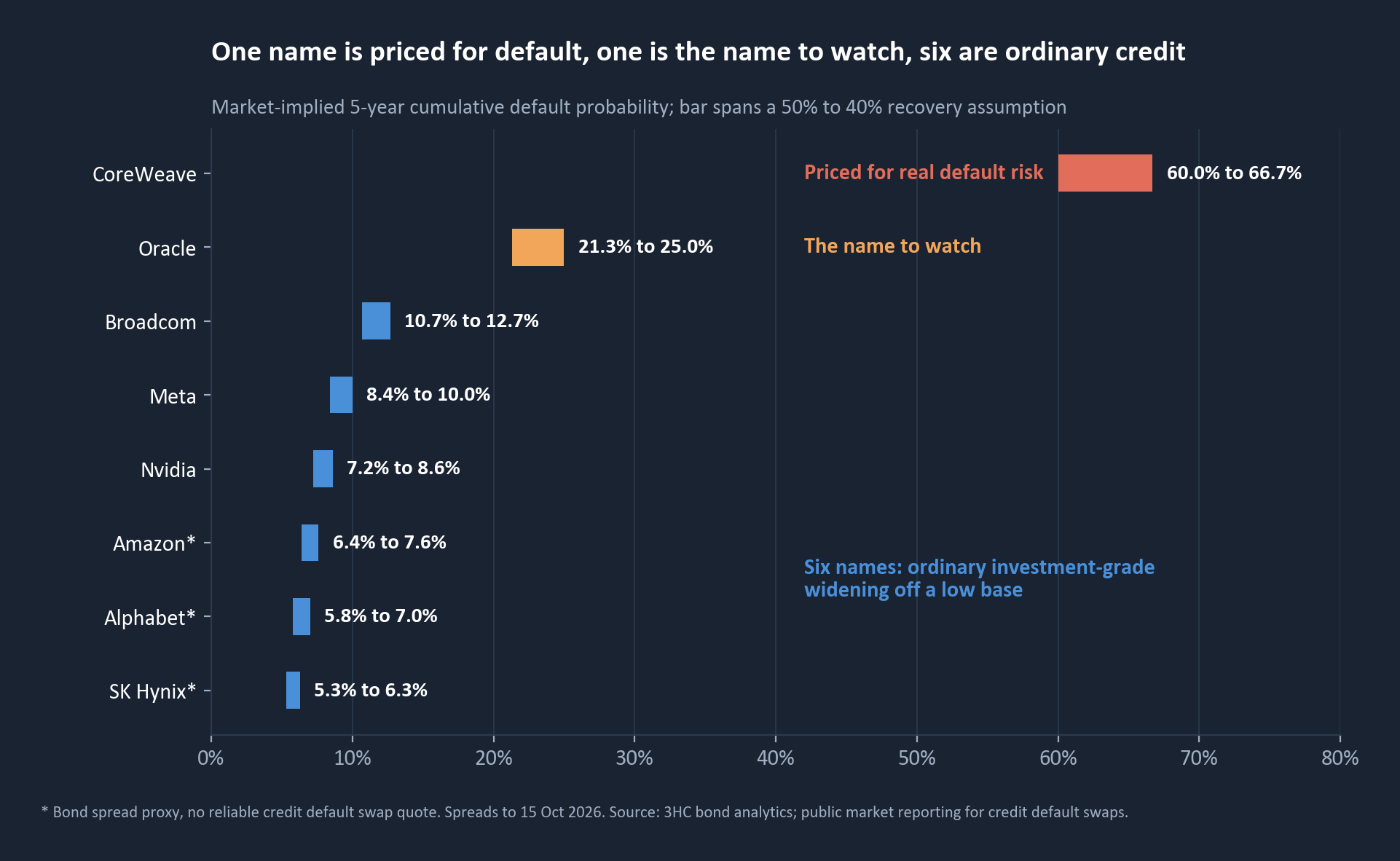
CoreWeave's market-implied 5-year default probability, the only name of the eight below investment grade
5% to 13%
The same measure for six of the eight names: ordinary investment-grade credit, widening off a low base
The finding in one line
The AI build-out is now a credit story, but not a sector-wide one: stress sits where the financing has been heaviest and most recent, and everywhere else spreads are widening off a low base.
The money came first
Hyperscaler and AI-linked issuers sold about $121bn of bonds in 2025, more than $90bn of it in the fourth quarter alone. Meta raised $25bn in one deal and a further $27bn through a data-centre joint venture that sits off its balance sheet. Oracle returned to the bond market for $18bn. CoreWeave's four tracked bonds total $7.75bn against a reported total debt load of about $50bn to $52bn, most of it equipment and project financing that bond-market data does not see. The two heaviest stress readings below sit with CoreWeave and Oracle, both of which borrowed in size in 2025.
Credit has priced it in three tiers
Turn each issuer's credit spread into a market-implied probability of default over five years and the eight names separate cleanly. CoreWeave sits at 60% to 67%. Oracle sits at 21% to 25%. The other six sit between 5% and 13%. These are order-of-magnitude readings: the recovery assumption alone moves each one by 5 to 7 points.
Four signals agree, name by name
Ratings, bond spreads, credit default swaps and equity were read separately. They rank the names the same way.
| Issuer | Bond spread now, change | Equity, 12m | Implied PD, 5y | Read |
|---|---|---|---|---|
| CoreWeave | 931bps, +72% | −49.9% | 60% to 67% | Real default risk |
| Oracle | 263bps, +83% | −55.1% | 21% to 25% | The name to watch |
| Broadcom | 98bps, +49% | −1.3% | 11% to 13% | Moderate, rising |
| Meta, Nvidia, Alphabet, Amazon | 67bps to 107bps | +3.0% to +39.5% | 6% to 10% | Ordinary investment grade |
| SK Hynix | 65bps, −2% | +216.7% | 5% to 6% | A divergence, not a credit story |
CoreWeave is the only name below investment grade (B/B1), and all four signals moved the same way on their own. Oracle is still BBB/Baa2, but its spread rose 119bps, by far the largest move among the investment-grade names, its swaps are at their widest since 2009, and its equity is down 55.1% over a year. The other six stayed within 40bps of where they started.
Not every record is a warning
Liquid credit default swaps on most of these names are new. Nvidia's 5-year market only became active in November 2025; Meta and Alphabet joined the main US investment-grade index in March 2026. A record set against two years of history is not the same signal as a record set against twenty. Our own bond spreads, a longer and verifiable series, confirm the direction and the ranking.
What changes for a portfolio
AI credit is not one exposure. The same issuers sit in equity books, investment-grade indices and private financing, and the market prices them in three distinct tiers.
- Look through to the issuer across every sleeve. One name in equity, index bonds and private credit is one exposure.
- Read issuance as an early signal. The stress sits where the 2025 financing was heaviest and most recent.
- Separate market structure from credit before treating a record as a warning.
- Size what the bond market cannot see, from off-balance-sheet vehicles to equipment financing.
- Hold tiers, not a sector call.
Read the full paper for the bond-spread paths, the swap levels, the equity record and the method.
Method: median option-adjusted spread across each issuer's tracked US dollar bonds (3HC bond analytics); credit default swap levels from public market reporting, 15 to 19 October 2026; PD(5y) ≈ 1 − exp(−spread × 5 / (1 − recovery)) at 40% and 50% recovery, with a bond spread proxy for Alphabet, Amazon and SK Hynix; US dollar total returns (3HC equity database). Research, not investment advice.