ETF strategy
Leverage Is a Trade, Not a Holding.
$130.5bn sits in the 20 largest leveraged and inverse ETFs. We set each one against its unlevered counterpart, and against the same leverage reset monthly or quarterly instead of daily. Whether leverage is worth it depends on what you are asking, and above all on how long you hold it.
Three Horizons Capital, Portfolio Analytics. Top 20 leveraged and inverse ETFs by assets and their unlevered counterparts; returns over roughly 12 and 24 months to 16 October 2026.
0.99% vs 0.28%
Average expense ratio of the 20 leveraged and inverse ETFs against their nine unlevered counterparts: a cost paid in every market
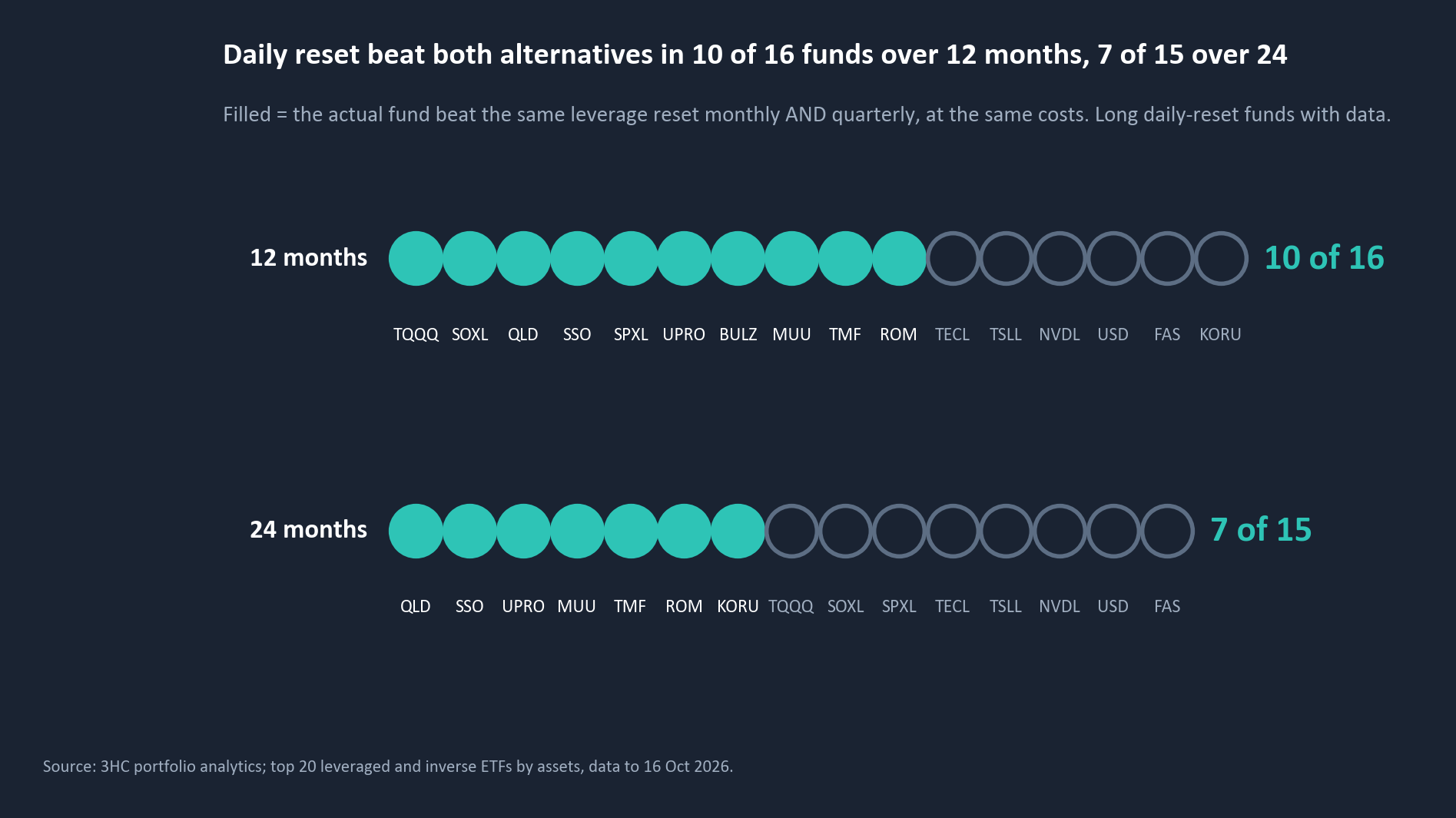
10 of 16 to 7 of 15
Long funds where the daily reset beat both a monthly and a quarterly reset, over 12 months and then over 24 months
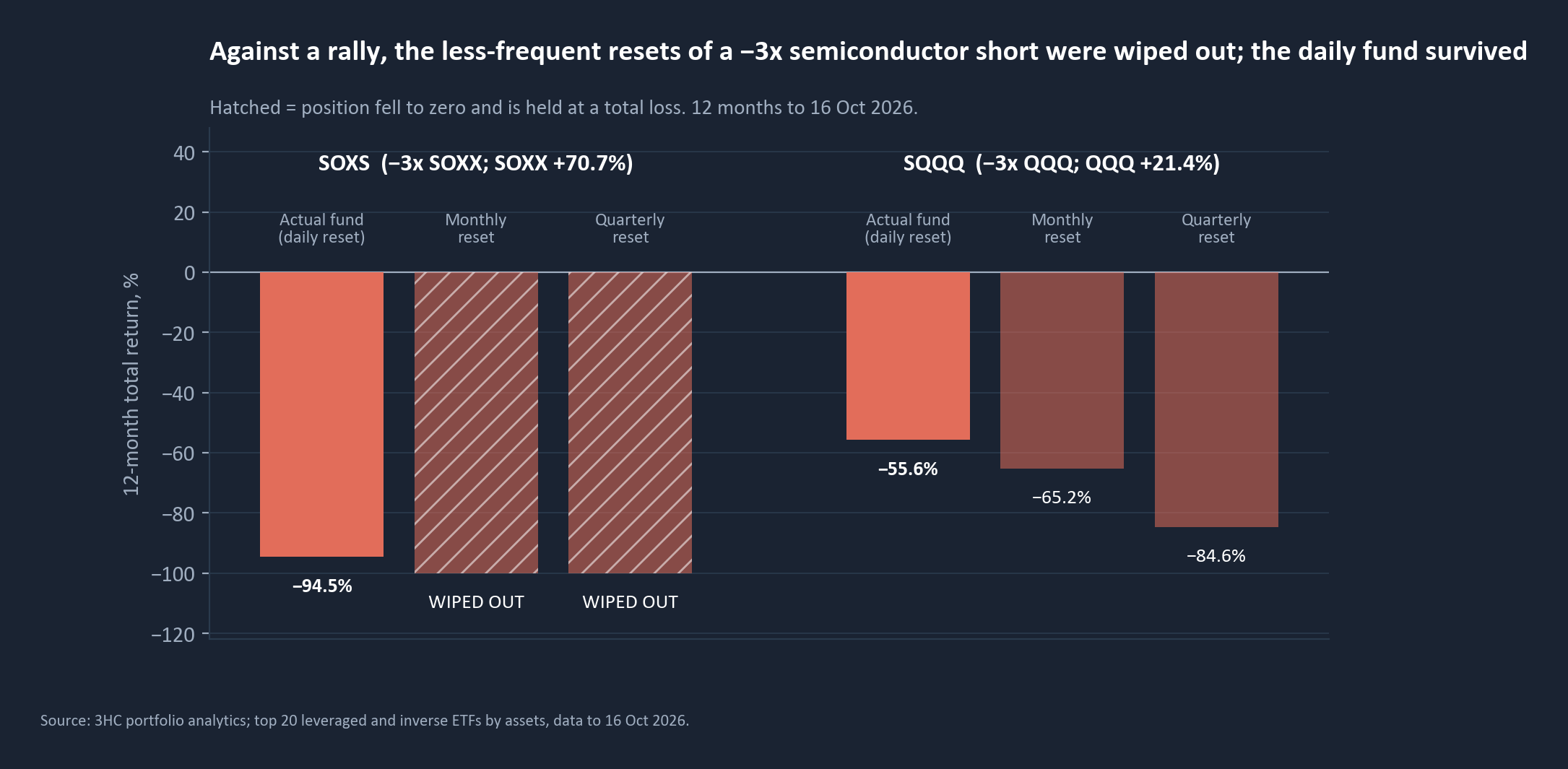
-94.5% vs wiped out
A -3x semiconductor short over 12 months: the daily-reset fund survived; the same position reset monthly or quarterly went to zero
The finding in one line
Leverage costs more in every market; on the long side its daily reset is a bet that your holding period trends, and on the short side it is insurance against ruin. It earns its place as a timed trade, not as a holding.
The cost is certain; the edge depends on the window
The 20 largest leveraged and inverse ETFs charge 0.99% a year on average, against 0.28% for their unlevered counterparts, in every market. We compared each fund with the same leverage reset monthly or quarterly, at the same costs. Over 12 months of a strongly trending market, the daily reset beat both alternatives in 10 of 16 long funds. Over 24 months it won in only 7 of 15. The two largest, TQQQ and SOXL, beat both alternatives over 12 months and then trailed the monthly reset over 24.
On the short side, it is a parachute
Against a semiconductor index that rose 70.7% in 12 months, a -3x short reset monthly or quarterly was wiped out. The daily-reset SOXS survived, down 94.5%: $100 became $5.50 rather than $0, because a daily reset limits each loss to one day's move. On the short side, daily reset buys survival, not return.
What this means for a portfolio
Is leverage worth it? On cost, no. On the long side, only if your holding period trends. On the short side, yes, as insurance against ruin.
- Set the holding period before the position, and size it for the fee.
- Judge it against the right alternative: how often the leverage resets, over what window.
- Watch what clients actually hold, and for how long. A product built for days and weeks behaves differently when it is held for years.
Read the full report for the full 20-fund scoreboard over 12 and 24 months, the monthly against quarterly results, both inverse funds and the method.
Method in the full report: actual fund returns against modelled monthly and quarterly resets at the same leverage and costs, with 4.35% a year financing. Research, not investment advice.