Portfolio construction
Every Options Product Has a Cousin You Already Own.
Investors are moving familiar jobs into options-based products. Each one does a job an equity strategy already does, and writes it into a contract with a price, a cap and a date. Compare it with its cousin on those three terms.
Three Horizons Capital, Portfolio Construction. US ETF flows to 31 Oct 2026; S&P 500 ETF option prices at the 6 Nov 2026 close, 4 Dec 2026 expiry. Research, not investment advice.
97%
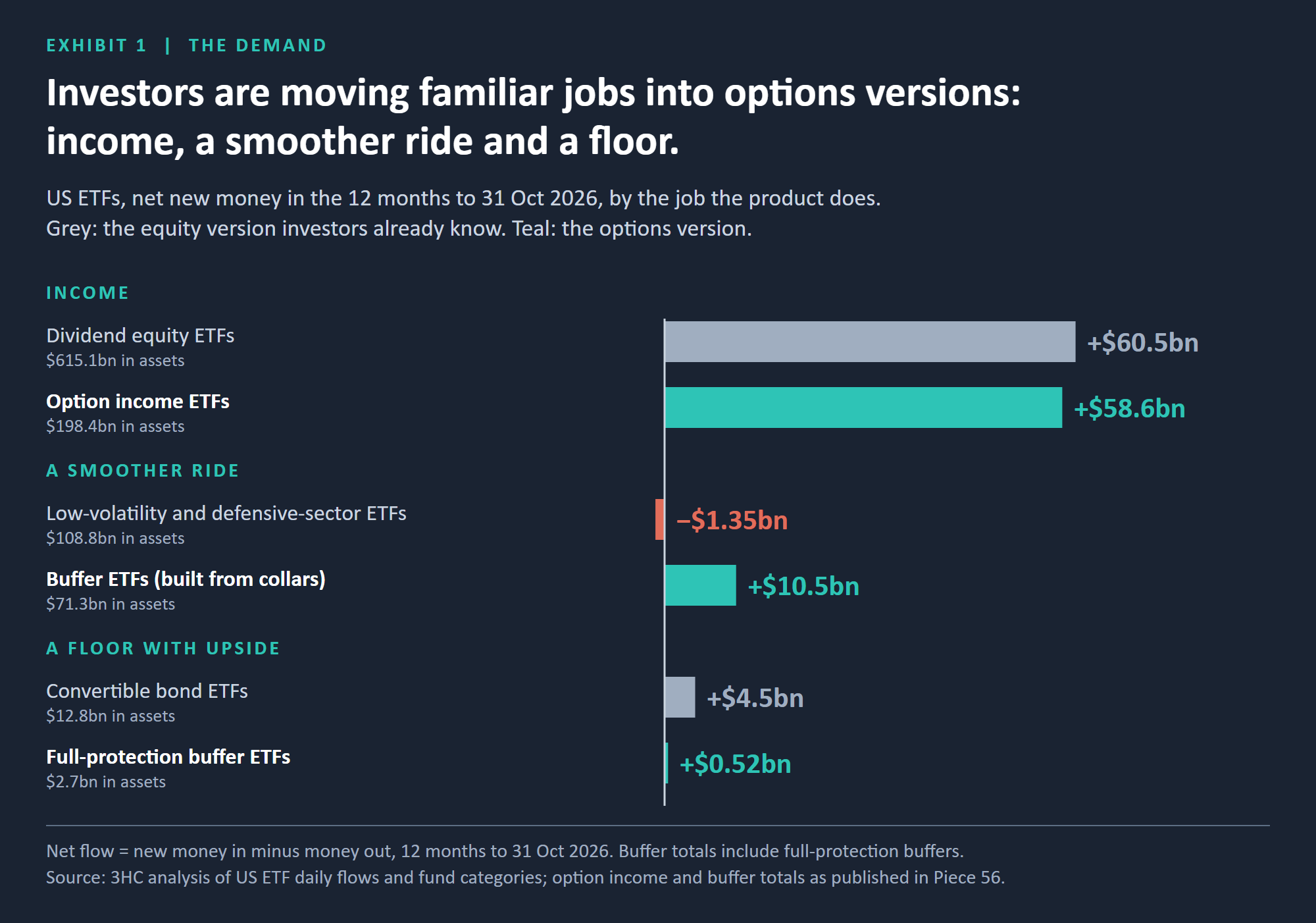
Option income ETFs took 97% as much new money as dividend ETFs over 12 months (+$58.6bn against +$60.5bn), from about a third of the assets
+$10.5bn
Into buffer ETFs over the same 12 months, while low-volatility and defensive-sector ETFs saw −$1.35bn
3.4 times
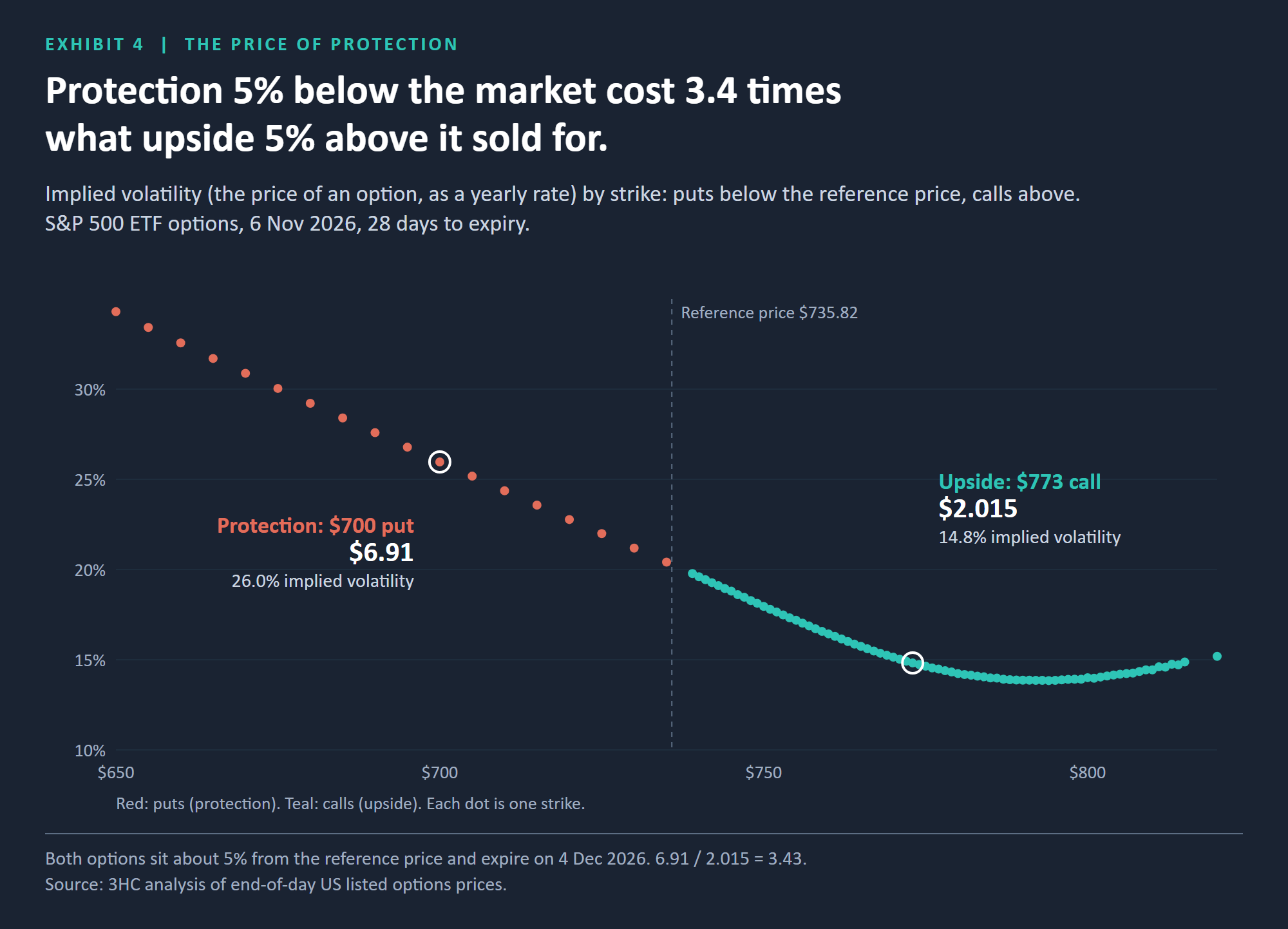
What protection 5% below the market cost, against what upside 5% above it sold for, on the same day and expiry
The finding in one line
Every options product does a job you already know; compare it with its equity cousin on three terms the contract sets: what it costs, what it gives up, and when it ends.
Investors are moving familiar jobs into options versions
Over the 12 months to 31 October 2026, US option income ETFs took +$58.6bn on $198.4bn of assets, against +$60.5bn on $615.1bn for dividend equity ETFs. Buffer ETFs, built from collars, took +$10.5bn on $71.3bn, while low-volatility and defensive-sector ETFs saw −$1.35bn on $108.8bn.
The job is the same; the contract is new
Each options product has an equity cousin. The equity version does its job through what it owns, so the outcome is statistical. The options version does it through a contract: a known premium, a written floor or cap, and an end date. On one S&P 500 ETF option chain (6 November 2026, 28 days to expiry, reference price $735.82, before costs):
| Pair | Equity cousin | Options version | On this chain |
|---|---|---|---|
| 1 | Equity ETF | Call spread | Costs 1.85% of the shares' value; gains stop at $773 |
| 2 | Dividend fund | Covered call | 0.82% income for 28 days; capped at +3.84% |
| 3 | Low-volatility fund | Put-write | 0.99% income on the cash; buys at 5.81% below if the market falls |
| 4 | Defensive basket | Collar | Loss limited to 3.30%; gain capped at 2.54% |
| 5 | Convertible bond fund | Stock plus a put | 2.10% for 28 days; floor −2.07% |
The price of protection decides what each product can offer
The $700 put, 5% below, cost $6.91; the $773 call, 5% above, cost $2.015. Protection cost 3.4 times what upside sold for. That is why selling puts pays more than selling calls, why a collar costs money unless the cap comes down (to +1.93% for a zero-cost version), and why buying the at-the-money put every 28 days would cost about 27% a year.
Three questions turn an options product into something you can compare:
- Which cousin does it replace? That is the benchmark for cost, income and risk.
- What does the contract give up, and at what price? The cap, the floor and the premium.
- When does it end, and what does renewing it cost? Ask for next period's terms at today's prices.
More research
The full paper works through all five pairs on the same chain, with the payoffs drawn: Every Options Product Has a Cousin You Already Own.
If you are weighing an options-based product against what you already hold, or building one, we are happy to run the comparison on its live terms with you on a call in the coming weeks.
Three Horizons Capital. Research, not investment advice. Figures before costs and taxes.