Product design
Five ETFs. Five Different Jobs.
Traditional, buffer, option income, autocallable, leveraged: each was built for a different job, and in the US, Europe and the UK the money, the investors and the shelves are moving toward the newer four. We mapped the five types across all three markets and the demand behind each. Then one note of caution: read the label, then the clock.
Three Horizons Capital, Portfolio Construction. US ETF data to 31 Oct 2026; European fund flows to 31 Oct 2026; Xetra statistics to Sep 2026; retail holder counts Oct 2026; platform product lists early Nov 2026. Research, not investment advice.
2.7% and 4.4%
US: the four newer types' share of US ETF assets, and of US ETF net inflows over the latest 12 months
About 18 times
Europe: growth in option income assets on Xetra over two years, from EUR 0.42bn to EUR 7.45bn
11 of 16
UK: UK investment platforms in our data that list option income ETFs
The finding in one line
Each type of ETF does a different job: know the job, read the label, and for three of the five, read the clock that decides the result.
Five types of ETF do five different jobs, and each is already bought in the US, Europe and the UK
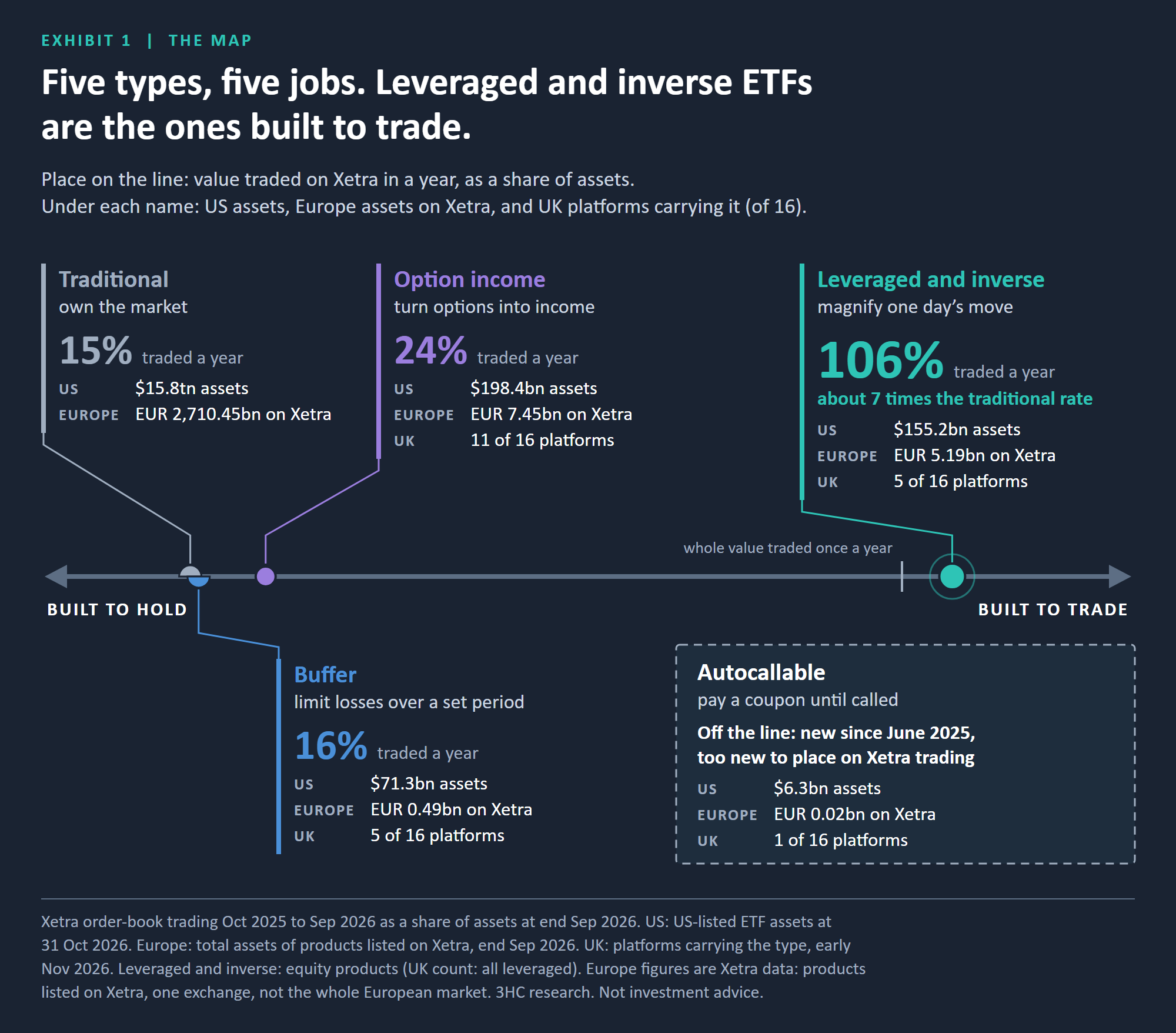
Every type below delivers what the ETF wrapper promises: daily liquidity, daily holdings and easy access. What separates them is the job each was built to do and what decides the result. For three of the five, that is a date.
| Type | The job | What decides your result | Clock? | The question to ask of the product |
|---|---|---|---|---|
| Traditional | Own a market or asset class at low cost, for years | Where the index starts and ends | No | What does it track, and what does it cost each year? |
| Buffer | Cushion a fall over a set period, giving up gains above a cap | When you buy into the outcome period | Yes | Where is the fund in its outcome period today, and what buffer and cap remain at today's price? |
| Option income | Turn some of a market's upside into regular income | How far markets rise | No | How much upside does the fund give up, and how has its income held across different markets? |
| Autocallable | Earn a coupon while markets do not fall too far | When each tranche was struck, against its barrier | Yes | How far is each live tranche from its barrier, and does a missed coupon come back later? |
| Leveraged and inverse | Magnify a short-term view, up or down | How long you hold: the leverage resets daily | Yes | What holding period is it designed for, and how does the daily reset behave over longer ones? |
Exchange data shows how they are used. On Xetra, leveraged equity products trade 106% of their assets in a year, against 15% for traditional ETFs, 16% for buffer and 24% for option income products. That is what leveraged funds are built for.
The money is moving toward the newer types in the US, and faster in Europe
In the US, the four newer types hold $431bn across 552 funds: 2.7% of the $16.2tn US ETF market, and 4.4% of its net inflows over the latest 12 months. Option income leads, with +$58.6bn of new money and growth of 29.5%. In our European fund data, option income grew 42.2% from new money and buffers 25.9%, against 14.8% for US buffers.
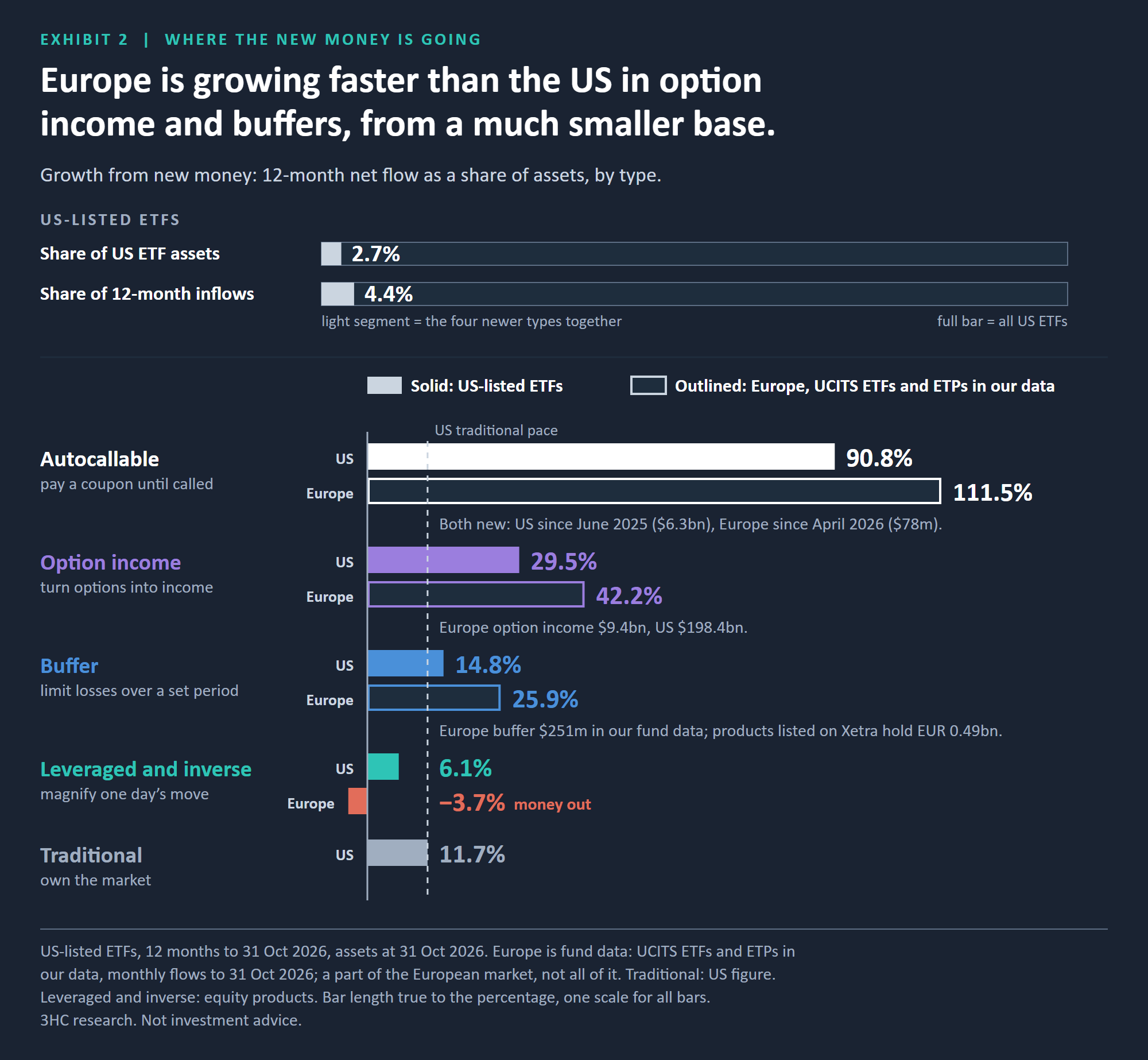
Europe is adopting from a small base. On Xetra, option income products went from 4, holding EUR 0.42bn, in September 2024 to 27, holding EUR 7.45bn, in September 2026: about 18 times in two years, against about 1.8 times for traditional ETFs.
Investors and shelves point the same way. On eToro, used across Europe and the UK, investors holding option income ETFs rose from 6,285 to 14,592 in a year (+132%; the year-ago count covers the products listed then) while the platform grew 17%. In the UK, option income is listed on 11 of the 16 platforms in our data, and across 154 platforms in 17 jurisdiction codes the newer types are already on the shelves.
Read the label, then the clock: for three of the five types, time decides the result
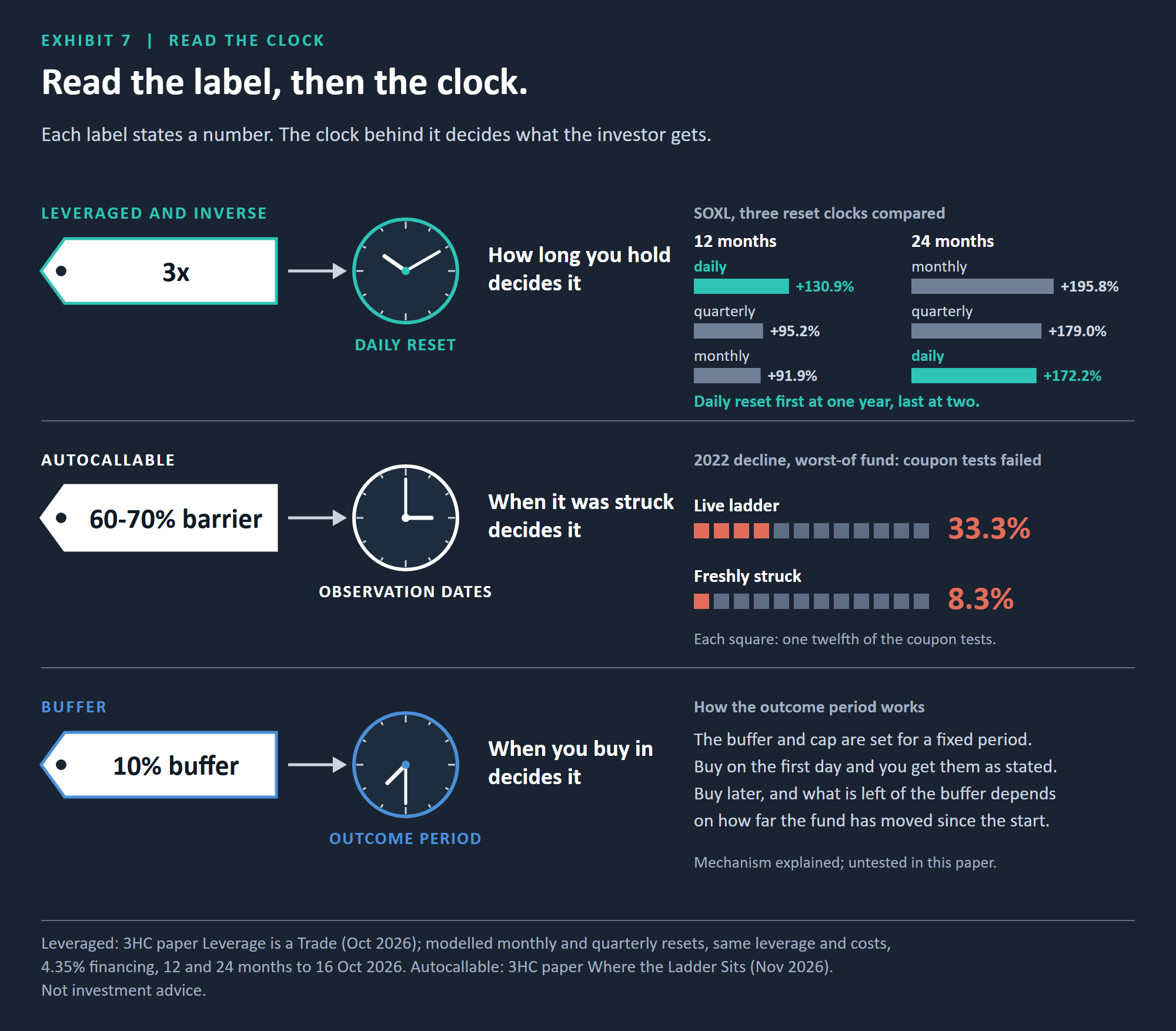
"3x", "60-70% barrier" and "10% buffer" describe the design accurately. For leveraged, autocallable and buffer ETFs, a date decides the result, on every exchange where they list. For traditional and option income ETFs, the market decides.
- Leveraged: how long you hold. The leverage resets daily, so longer returns depend on the market's path. In our leverage paper, SOXL came first of three reset designs at one year and third at two.
- Autocallable: when each tranche was struck. In the 2022 decline, a worst-of fund's live ladder would have failed 33.3% of coupon tests, against 8.3% for a freshly struck ladder.
- Buffer: when you buy into the outcome period. The buffer and cap are set at the start of each period; buying partway through means inheriting the market's move since then. Next in this series, we test the buffer clock.
The questions in the section 01 table apply on every shelf, US, European or UK.
If this is useful
If you issue, list or select these products, we can map your shelf or product against demand in each market, US, European and UK, and walk through it on a call in the coming weeks. Get in touch
Method in the full report: US daily shares outstanding times net asset value to 31 October 2026; European monthly fund flows to 31 October 2026; Xetra statistics September 2024 to September 2026, and order-book trading October 2025 to September 2026 as a share of assets; retail holder counts, October 2025 to October 2026, counting investors rather than money; platform product lists, early November 2026, counting availability rather than holdings. Xetra and our European fund data are different product sets. Flows are not returns. Earlier findings are quoted as published. Source: Three Horizons Capital analysis. Research, not investment advice.
More research
- Leverage is a Trade: when the daily reset helps, and when the holding period works against it.
- Where the Ladder Sits: autocallable ETF ladders run through three past sell-offs.
If this is useful
This read joins US and European flows, two years of Xetra listings, retail holder counts and 154 platform shelves on one platform. If you issue, list or select these products and want the same view of your own range, market by market, talk to us. Get in touch